What "Blackout" Actually Means
Most people use the word blackout loosely. In tattooing it describes something specific — a tattoo where large areas of skin are filled with solid, saturated black, leaving no skin tone and no grey within those areas. It is the opposite of light-handed work. Instead of an image sitting on top of the body, the black becomes part of the body's silhouette.
Heavy coverage sits on the same spectrum. It refers to designs that dedicate a large proportion of their surface area to dense black — bold fills, thick ornamental bands, solid panels, and graphic shapes — without necessarily covering every centimetre. The distinction matters, because it changes how the piece is designed, how it is executed, and how it is lived with.
The Spectrum From Heavy Shading to True Blackout
It helps to picture blackwork as a gradient of commitment.
- Heavy shading — dark, densely packed grey work that reads as near-black from a distance but still contains tonal variation and visible skin breaks.
- Solid fill work — deliberate blocks of packed black inside a wider composition, such as the interior of a letter or the background of a geometric panel.
- Full blackout — whole areas, from a forearm panel to an entire limb or a section of back, saturated to the edges, with no image to hide behind and no gradient to soften the edge.
A heavily shaded piece and a true blackout can look similar in a dim photo. They are not the same tattoo, and they do not behave the same way on the skin.
Why Negative Space Is Everything
The single thing that separates a strong blackout from a black rectangle is the space left un-inked.
Good heavy-coverage design treats untouched skin as an active element rather than a gap to be filled later. A fine line of skin inside a solid black field can read as a crack of light. A ring of negative space around a curve can describe the shape of an arm more clearly than any outline. Flood that same field completely and you lose all of it — the piece flattens, the silhouette disappears, and the tattoo stops saying anything.
This is why heavy coverage is a design discipline before it is a technical one. The artist is deciding what to remove as much as what to put in.

The Ornamental and Geometric Approach
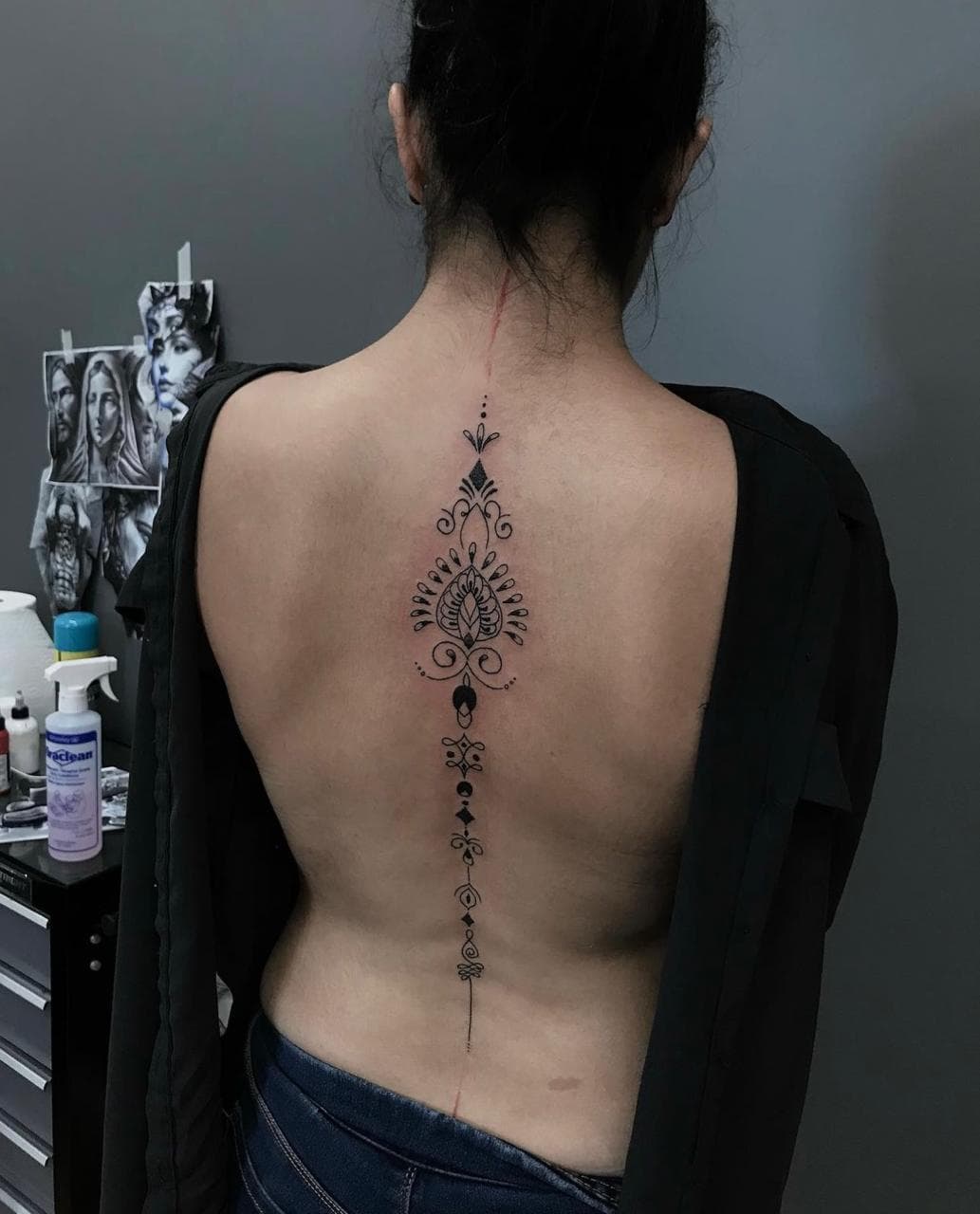
Much of the most successful heavy-coverage work is ornamental or geometric rather than figurative. Patterns built from repeating modules — bands, chevrons, chains of diamonds, solid panes between fine filigree — suit dense black particularly well, because the structure itself supplies the contrast.
Because the design is built from tiles or repeated units, it can also be extended across a growing area in stages, with each stage reading as complete on its own. If you're drawn to this direction, it's worth understanding how it fits into a broader placement plan, much like planning a custom tattoo sleeve, where the composition of the whole arm matters as much as any single session.
Blackout Over Old Work: When a Cover-Up Isn't Achievable
Blackout is often the honest answer to a difficult problem. Some old tattoos cannot be covered in the conventional sense. They're too dark, too saturated, sitting awkwardly, or carrying so much solid ink that no design can disguise them without becoming a heavier block itself.
In those cases the realistic route is to stop trying to hide the old work and instead absorb it into a much larger field of black, then design the new piece around and through that field, starting from cover-up and rework planning. A shape placed inside the black, a band of negative space cutting through it, a ring of fine detail around its edge — any of these can turn a problem area into the anchor of a deliberate composition.
The trade-off is plain. You are adding permanent black over permanent black, and the skin available for future tattoos shrinks accordingly. That is a decision worth making with clear eyes, and with an honest assessment — a consultation through our studio services is usually where that conversation belongs.
The Practical Realities
There is no honest way to write about heavy coverage without talking about what it asks of the body.
- Multiple long sessions — solid black is slow to lay in and slow to heal, so covering a large area usually means several sessions spaced weeks apart.
- Significant discomfort — packing solid black means working the same skin repeatedly with dense needle groupings, which many people find more intense than linework.
- Skin trauma — heavy saturation over a large surface is hard on the skin, and healing between sessions is not optional.
- No going back — a blackout forecloses most future options for that area. Laser can lighten black, but it is slow, costly, and rarely restores skin to a blank slate.
How Heavy Black Behaves as You Age
Skin stretches, sags, and changes over decades, and large solid areas show that change more visibly than fine detail does. A black panel on the upper arm will move and soften as the skin beneath it changes.
It won't vanish, and solid black generally holds its colour far better than fine shading does. But edges can soften, and small negative-space details can blur with time. That is another reason to design negative space generously: fine cracks of skin that look perfect fresh may close up, while wider breaks in the black age far more gracefully — a principle that applies across blackwork and to how tattoos age over time.
Sun, Heat, and Living With Large Black Areas
Large black areas absorb heat, and in a climate like Darwin's that is a genuine practical consideration. Black ink does not tan, so a heavily blacked-out limb doesn't have the same relationship with sun exposure as the rest of your skin. It needs ongoing protection — sunscreen, clothing, and shade — not just during healing, but for life.
Fresh heavy coverage also needs careful aftercare. Friction and repeated abrasion across a large healing area can compromise a result that took many hours to build, so protecting it matters more, not less, when the area is large.
What Makes a Surface Suitable
Not every body area, and not every person, is a good candidate for a full blackout. Factors that matter include:
- Skin condition and elasticity — healthy, unbroken skin holds dense black far more reliably than skin that is scarred or fragile.
- Body area and contour — flat, reasonably broad surfaces saturate more evenly than bony or highly curved areas.
- Existing work underneath — what is already there shapes what is possible.
- Lifestyle and sun exposure — unavoidable, high sun exposure on a large black area means constant maintenance.
- Willingness to commit — a blackout is a long-term relationship with your own skin, and it rewards patience over impulse.
A Decision to Make Properly
Blackwork at its best is striking, confident, and deeply personal. It is also one of the least reversible choices in tattooing. Done well — designed with real negative space, executed in careful stages, and healed with the same discipline it was made with — it can be one of the most powerful things a person can wear. Done impulsively, it becomes a permanent problem with very few ways out.
If you're considering heavy coverage, the conversation to have is a detailed one: what the area currently holds, what can be absorbed, and how the composition will develop over years rather than weeks. That planning is where a strong blackout is separated from a black rectangle — long before the needle touches skin.