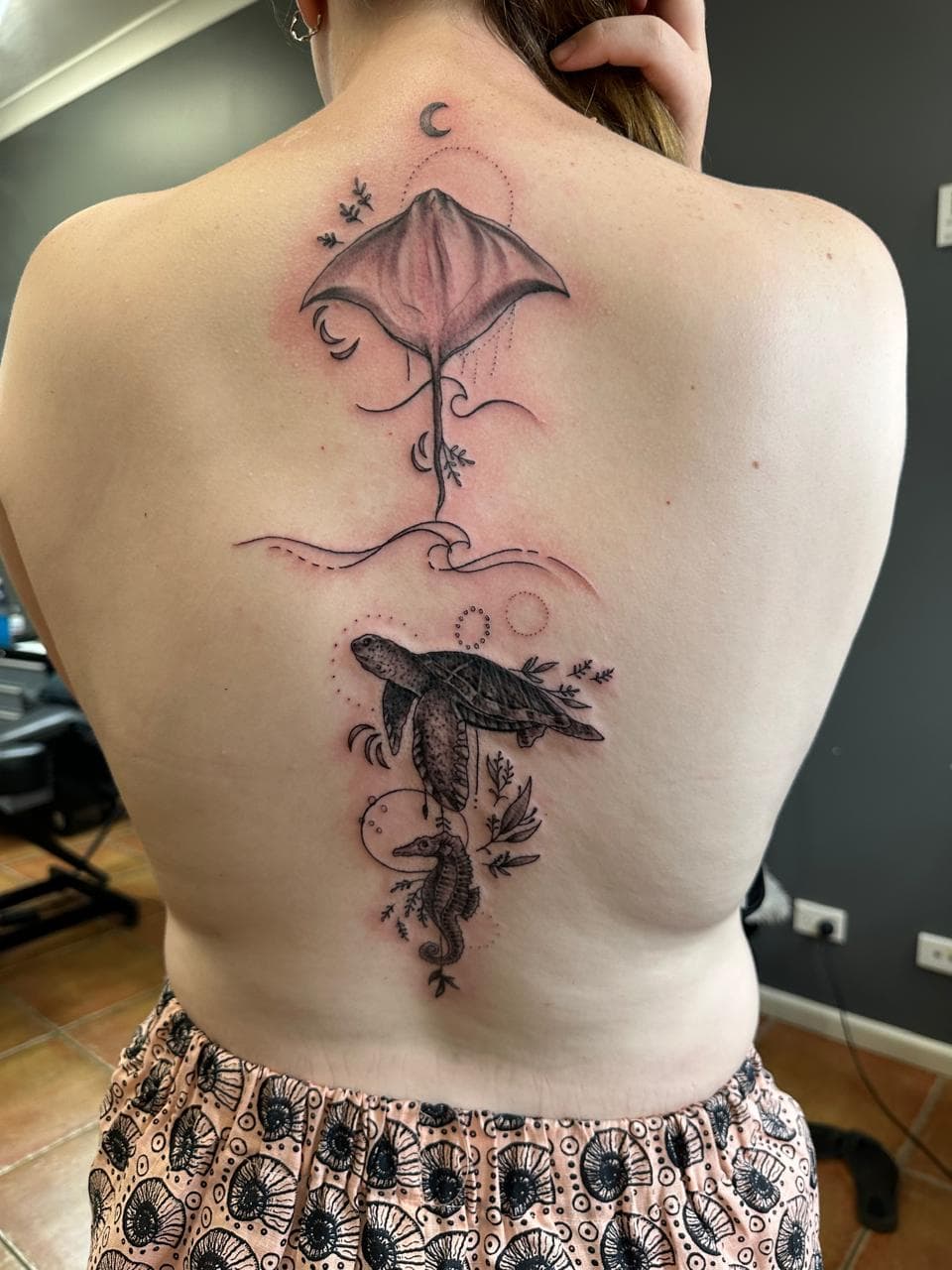
The Northern Territory Has Some of the Highest UV on Earth
If you live in Darwin or anywhere in the Top End, you already know the sun here doesn't behave the way it does in southern Australia, let alone Europe or North America. The Northern Territory sits close to the equator, and UV levels regularly reach extremes — often hitting 11 or higher on the standard index, a level sun-safety authorities treat as dangerous within minutes. That intensity is not just a summer thing. It holds through much of the year.
For tattoos, this matters more than almost anything else you'll do after healing. UV is the single biggest driver of tattoo fading and blurring over time.
How UV Breaks Down a Tattoo
Tattoo ink sits in the dermis, the deeper layer of skin below the surface. That's why the pigment stays. But it isn't inert, and sunlight keeps working on it.
UV radiation does a few things at once:
- Breaks down pigment particles — over years, UV exposure causes the ink to degrade and spread, and the crispness softens.
- Damages the surrounding skin — UV thins and ages the skin around the tattoo, which changes how the ink reads through it.
- Triggers inflammation — repeated sun exposure keeps the area under low-grade stress.
- Accelerates fading — dark inks and fine line work lose definition fastest, and colour can shift and dull.
A tattoo kept out of the sun and one exposed to it every day will not look the same in ten years. In the NT, that gap is wider than in cooler climates.
Fresh Tattoos Are Especially Vulnerable
A new tattoo is a wound, and the skin barrier is disrupted for weeks after the session. That combination makes the area far more sensitive to UV than ordinary skin.
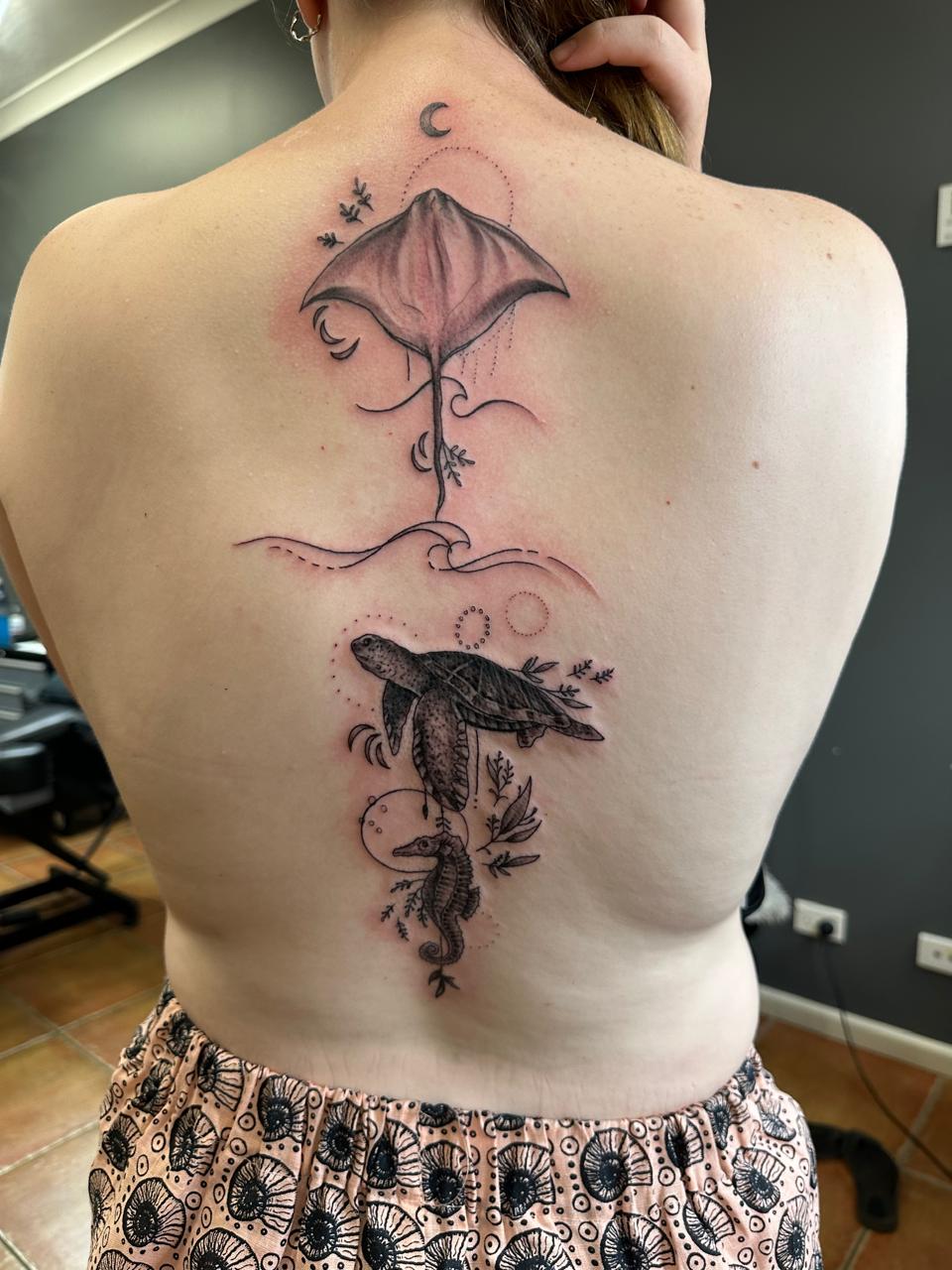
A few things are worth knowing:
- Don't put sunscreen on an unhealed tattoo unless your artist has specifically told you to. The barrier isn't intact, and the product can irritate open skin.
- Keep it covered and out of direct sun while it heals — physical cover, not chemical.
- Assume the sun will find it — even brief errands add up in NT conditions.
For the healing period itself, our guide to healing a tattoo in Darwin's tropical climate covers the day-to-day detail.
The Realistic Sunscreen Approach
Once the tattoo is fully healed, sunscreen becomes the baseline, not the whole answer.
- SPF 50+ — Australian sun-safety guidance recommends SPF 50 or 50+ for extended outdoor time. Lower ratings are not enough in extreme UV.
- Reapply every two hours — and more often if you're sweating or moving in and out of water.
- Broad spectrum — you want protection from both UVA and UVB.
- Don't rely on it alone — sunscreen wears off, gets rubbed off, and is rarely applied thickly enough.
In a place with UV this high, sunscreen is a layer of defence, not a force field.
Physical Cover Beats Sunscreen
In NT conditions, physical cover is the more reliable option.
- Shade — plan your day around it, not just around sunscreen.
- Clothing — a high-collared shirt, a scarf, or a light long-sleeve layer over an arm or shoulder piece.
- Hats — broad-brimmed and covering the neck and ears, not just a cap peak.
- UV clothing — rated fabric does what a thin cotton shirt often won't.
- Timing — outside the middle of the day, UV is lower, though in the NT it stays high far longer than in the south.
Sunscreen plus cover plus shade is the combination that actually works.
Sweat, Water, and Reapplication
Sunscreen that's been swimming, sweating, or towelling off is sunscreen that's gone. In the NT, sweat is a constant.
- Reapply after swimming, even with "water resistant" formulas.
- Reapply after heavy sweating — sport, manual work, humidity.
- Reapply after towelling — drying off removes product.
If you're getting back in the water with a healed tattoo, our article on when you can swim after a tattoo covers the timing.
The Wet Season Changes the Picture
Darwin's seasons don't follow the southern pattern. The wet season and the build-up shift daily UV and how much time you spend outside.
- The build-up — extreme heat and humidity, high UV, and people spending more time outdoors in the evening.
- The wet season — cloud cover feels protective but doesn't block UV the way people assume; it can still be extreme.
- Overcast days — UV passes through cloud, so a grey day is not a free pass.
- Reflected UV — water and pale surfaces bounce UV back onto skin, which matters near the coast, on boats, or fishing.
The assumption that "it's cloudy, so I'm fine" is one of the most common mistakes here.
Why This Looks Different From Cold-Climate Guides
Most tattoo sun-protection advice is written for places with mild summers and short UV seasons. In the NT, several assumptions don't hold:
- It's a year-round issue — not a three-month summer concern.
- Cloud isn't protection — the UV index stays high regardless.
- Daily habits matter more — the cumulative exposure of ordinary life is the real risk.
- Healing windows are more exposed — there's less benign weather to hide a fresh tattoo in.
General Skin Health Helps the Tattoo
A tattoo looks better when the skin around it is healthy. Stay hydrated, moisturise regularly, and keep the area clean.
See a Doctor for Skin Concerns
This article is general information, not medical advice. If you notice a mole or spot that changes in size, shape, colour, or texture, or anything that bleeds, itches persistently, or doesn't heal, see a doctor. In the NT, regular skin checks are a sensible habit independent of tattoos — and worth doing whether or not you have visible ink. Checking your moles and protecting your tattoos are two separate habits, and both are worth keeping.
Protecting Tattoos Here Takes Consistency
The NT is a wonderful place to live and an unforgiving place to leave skin exposed. Tattoos here need sun protection treated as a habit rather than an occasional effort — shade and cover first, sunscreen reapplied through the day, and a doctor for anything that looks wrong. Do that and the work you've invested in stays as close to its original sharpness as it can.