The Sea in Ink
Tattooing and the sea have been inseparable for hundreds of years. The oldest documented Western tattoo traditions come from sailors — men who spent months or years at sea, collecting marks on their bodies to mark milestones, remember home, and carry protection through storms and unknown waters.
Today, maritime tattoo motifs are as popular as ever. But many people wear them without knowing the original meanings behind the imagery. Whether you're drawn to the ocean for personal reasons, grew up near it, or simply love the aesthetic, understanding the symbolism gives the design more weight.
The Classics: What Each Symbol Originally Meant
Anchor
The anchor is the most widely used maritime tattoo in the world. Originally, a sailor would get an anchor only after crossing the Atlantic Ocean — a milestone that meant they'd proved themselves in rough open water. The anchor represented stability, safety, and returning home.
Modern meaning: grounding, stability in difficult times, holding fast through change, love for the sea or a port city. Anchors are also used as memorial pieces for someone who was "your anchor" in life.
Swallow
A single swallow meant a sailor had travelled 5,000 nautical miles. Two swallows meant 10,000 — a veteran of some of the longest commercial routes in the age of sail. Swallows were also a symbol of return: legend said that if a sailor drowned at sea, the swallows would carry his soul home.
Modern meaning: coming home after being away, long journeys safely completed, freedom, migration, or a connection to a place you left and hope to return to.
Compass Rose
A compass rose tattoo on a sailor's hand or forearm meant that man was a navigator — trusted to plot the course and get the crew home. It was a mark of skill and responsibility, not just decoration.
Modern meaning: guidance, finding your way, staying true to your direction, or a reminder that you always know the way home even when things feel lost.
Nautical Star
The five-pointed nautical star was tattooed on sailors' hands or wrists as a good luck charm for navigation. It was particularly important for men who worked at night, when the North Star was often the only reliable reference point.
Modern meaning: protection during travel, guidance, hope, and the idea that something steady will always show you the way.
Ship
A full sailing ship tattoo originally meant a sailor had rounded Cape Horn — the notoriously dangerous stretch of water between South America and Antarctica. Surviving that passage was the highest mark of seamanship a man could earn.
Modern meaning: adventure, a voyage you've completed or are about to embark on, overcoming adversity, or simply a love for the romance of the open ocean.
Modern Maritime Motifs and Their Meanings
Traditional sailors didn't tattoo everything we see today, but these motifs have developed their own established meanings in modern tattoo culture.
Sea Turtle
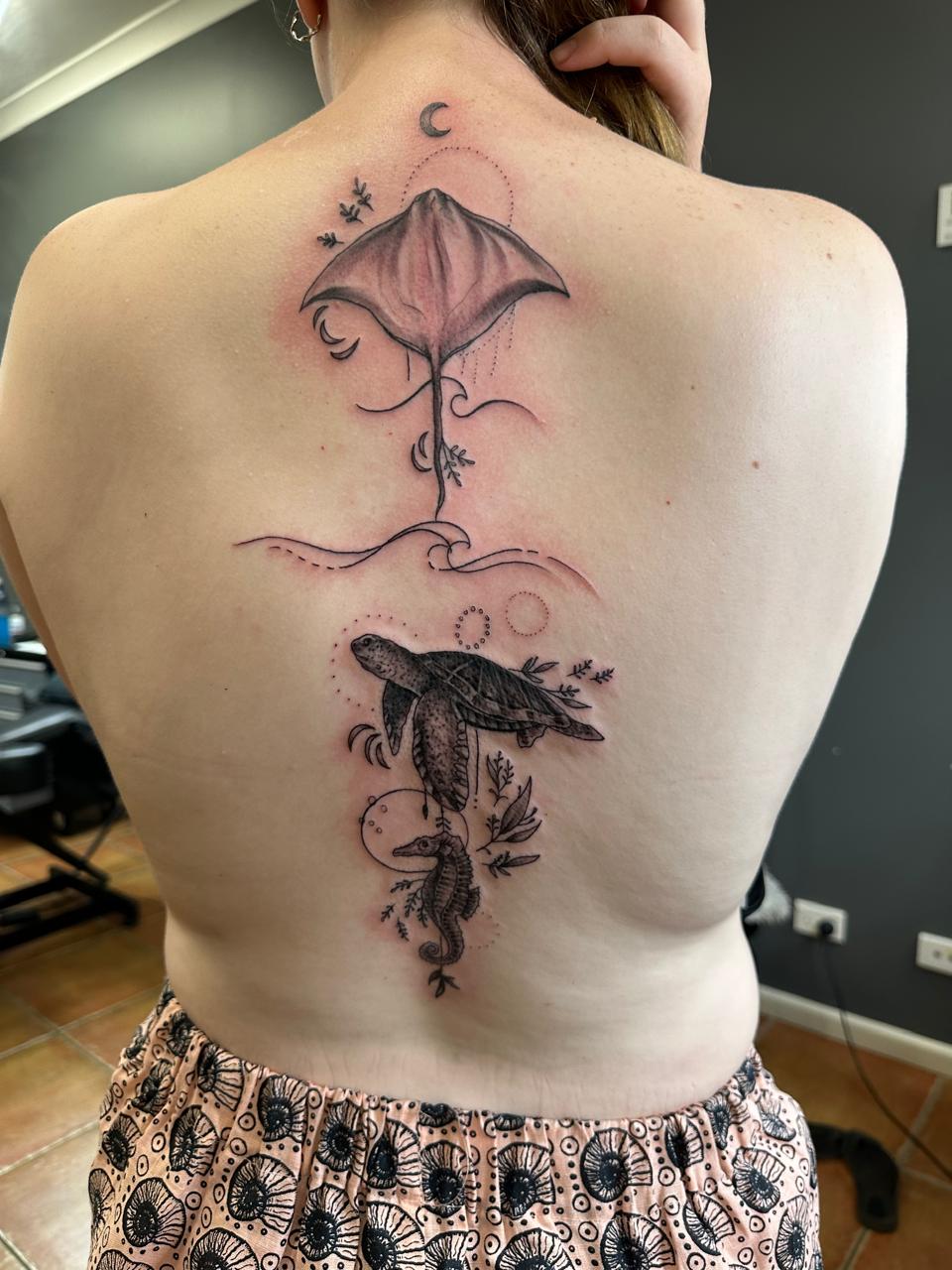
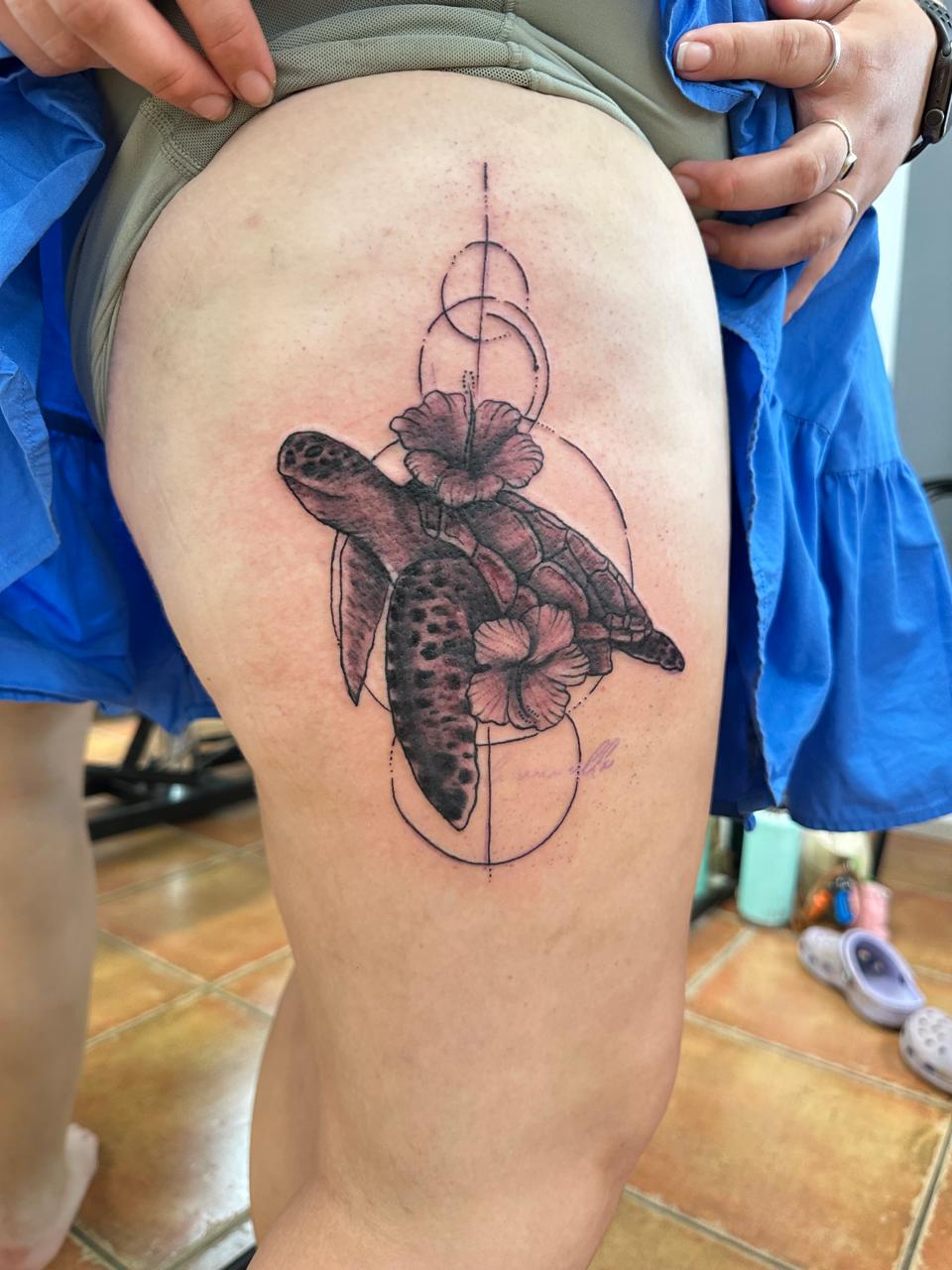
Sea turtles are a relative newcomer to maritime tattoo symbolism, but they've quickly become one of the most popular. They represent long life, resilience, safe travel over long distances — drawn from the fact that turtles navigate thousands of miles of open ocean and always return to the beach where they were born. For people who travel, move countries, or feel far from home, a sea turtle is a quiet promise that you'll find your way back.
Jellyfish
Jellyfish are a surprisingly loaded symbol. Their lack of brain, their dependence on the currents, and their quiet beauty have made them stand for going with the flow, resilience, and finding beauty in things that drift rather than steer. They're also associated with soft power — something that looks delicate but has a powerful sting.
Wave and Water Patterns
Japanese-style wave tattoos have become mainstream in Western tattooing, particularly fine line and single-needle interpretations. Waves mean flow, change, the rhythm of life, and the idea that water always finds a way. A single wave is often a reminder that even the biggest things come and go.
Koi Fish
Koi are part of the Japanese tradition rather than Western maritime tattooing, but they're a staple of ocean and water-themed sleeves. Swimming upstream koi represent perseverance, struggle, and overcoming adversity to achieve your goals. Swimming downstream koi mean you've already completed that struggle and are at peace with where you are. A koi turning into a dragon — a common mythological motif — is the ultimate symbol of transformation through effort.
Octopus and Kraken
The octopus or kraken motif originated as a sailor's warning about deep, unknown dangers. Today it's more likely to stand for intelligence, complexity, versatility, and the parts of yourself you keep hidden. Octopuses are also associated with adaptation — they can change shape, colour, and strategy to match any situation.
Building a Maritime Piece
Ocean-themed tattoos work beautifully at every scale, from micro fine line pieces to full sleeves and back pieces. Here's how to approach yours.
Small pieces
A single anchor, a tiny swallow, or a minimal wave pattern work wonderfully as stand-alone pieces. Keep the design clean and uncluttered — maritime symbols are already recognisable, so they don't need help. Perfect placement: wrist, behind ear, finger, ankle, ribs.
Medium pieces
A sea turtle surrounded by waves, a compass rose framed by rope, or a full swell wrapping around the forearm. Medium maritime pieces give you room for detail without committing to a full sleeve. Perfect placement: upper arm, calf, thigh, sternum.
Large-scale and sleeves
The classic maritime sleeve is a scene: a tall ship on a choppy sea, compass rose behind it, a swallow on each wrist, rope borders, and maybe a lighthouse or anchor somewhere in the composition. Modern versions often blend Japanese and Western styles — koi swimming alongside swallows, wave patterns framing a sailing ship.
One trick that always works: work with the flow of your body. Let waves wrap naturally around the arm's curve, let the ship's sails echo the shape of your shoulder, let the rope border follow the natural line of your forearm. A good artist will plan the piece around your anatomy, not just paste a design onto skin.
Why Maritime Tattoos Age So Well
The classic maritime symbols work for a reason beyond their meaning. They're all bold, graphic shapes with strong lines and clear silhouette. Anchors, swallows, compass roses, and waves all read instantly from a distance — no one has to squint to work out what they're looking at. That boldness translates directly into long-term wear.
Maritime imagery also translates across every style. The same anchor can be done in traditional thick lines, delicate fine line, full neo-traditional ornamentation, or black and grey realism. It still reads as an anchor, it still carries the same weight, and it will still look great in twenty years.
Whether you're a sailor, a surfer, someone who grew up on the coast, or just someone who feels more like themselves near the water, maritime tattooing has a symbol that fits.