Between the Photograph and the Drawing
Tattooing exists on a spectrum between two poles. At one end is realism — tattoos that aspire to the precision of photography, rendering subjects with exact tonal accuracy and three-dimensional depth. At the other is graphic or traditional work — bold outlines, flat fills, and simplified forms.
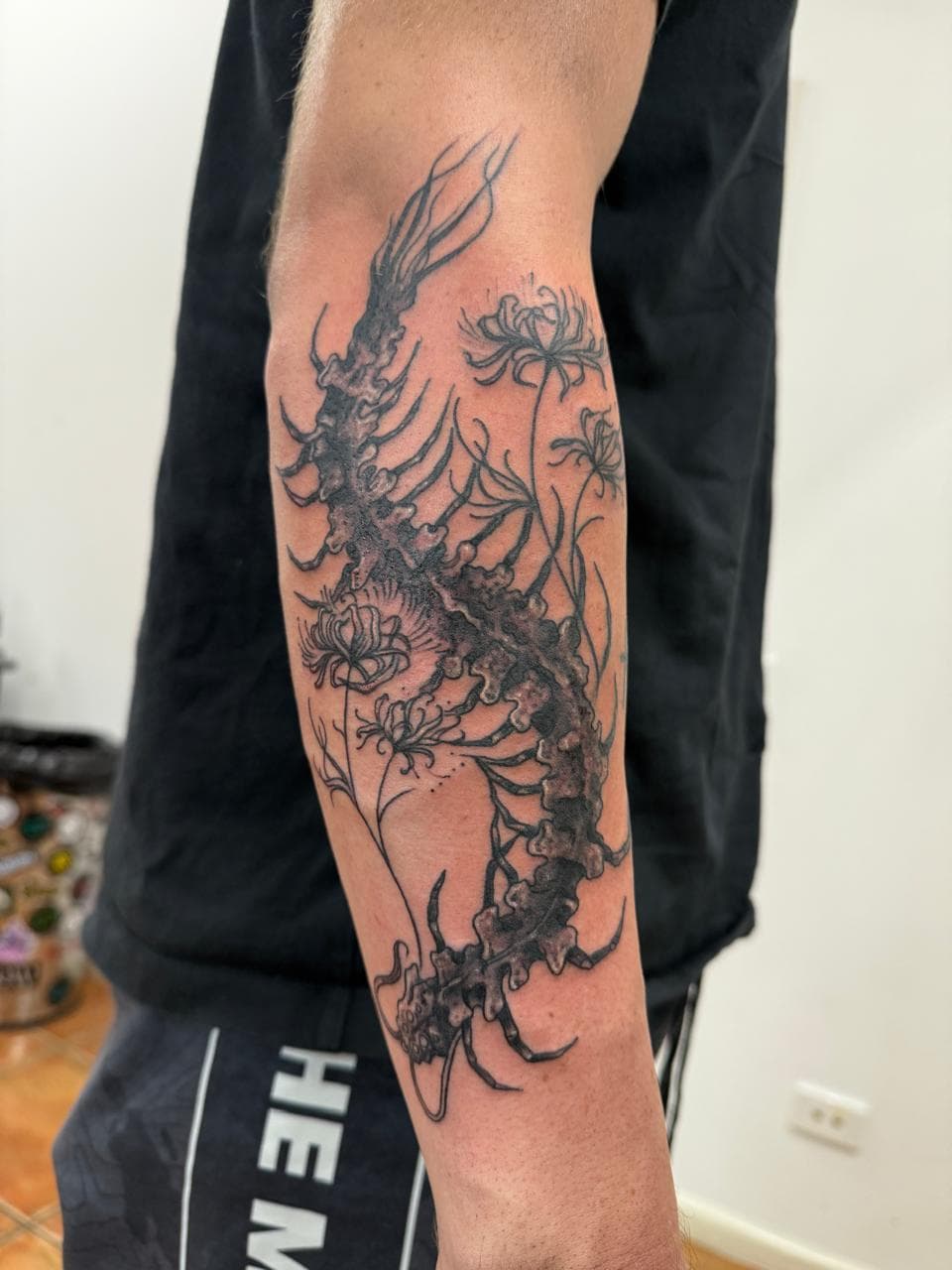
Illustrative tattooing occupies the rich middle ground. It draws from the visual language of editorial illustration, scientific drawings, fine art prints, and concept art — work that is clearly drawn rather than photographed, but deeply detailed and expressive rather than simplified.
The result is a style that feels handcrafted in the best sense: you can see the artist's sensibility in every line.
What Defines the Style
No single set of rules governs illustrative tattooing — that flexibility is part of its appeal. But several characteristics appear consistently in strong illustrative work:
Expressive linework — lines vary in weight and character, often thickening and thinning in ways that reference pen and ink drawing or engraving. This gives forms energy and three-dimensionality without requiring photorealistic shading.
Visible technique — unlike realism, where the goal is to hide the method, illustrative work often celebrates it. Cross-hatching, stippling, and directional stroke patterns are left visible as part of the aesthetic.
Stylised anatomy — subjects are rendered accurately enough to be clearly readable, but proportions and details may be interpreted or exaggerated for visual impact.
Dark and light contrast — strong tonal range is typical, often using solid black areas balanced against fine detail and open negative space.
Narrative quality — illustrative tattoos often feel like they tell a story or convey a mood. They have a sense of composition beyond just depicting a subject.
What It Works Best For
The illustrative style is remarkably versatile, but certain subjects are particularly well suited to it:
Natural history subjects — insects, botanical elements, birds, sea creatures, and animals rendered in the tradition of scientific illustration. The style's roots in pen-and-ink drawing feel natural here.
Dark or surreal imagery — the style handles macabre, gothic, and fantastical subjects beautifully. Horror iconography, mythological creatures, and surrealist compositions all gain character from illustrative technique.
Portraits with character — not photorealistic portraits, but interpreted ones. Illustrative portraits often capture personality more than literal likeness, making them powerful for memorial pieces or character studies.
Flora and fauna — flowers, plants, and animals translated through an artist's personal drawing sensibility rather than rendered as exact copies.
Storybook and folklore imagery — fairy tales, folk art, mythology, and fable material feels at home in this style.
Colour vs. Black and Grey
Illustrative work appears in both colour and black and grey, with quite different results.
Black and grey illustrative tends toward the graphic and sculptural — the tonal range is achieved purely through ink density and line density. This approach ages exceptionally well.
Colour illustrative can be vibrant and painterly, using colour much as a watercolour or gouache illustrator would — with areas of rich saturation, careful blending, and deliberate restraint.
Some of the most interesting work in this category mixes a predominantly black-and-grey foundation with selective colour accents — a red flower against a monochrome botanical composition, for instance.
Choosing an Illustrative Artist
Because illustrative tattooing is so closely tied to an individual's drawing sensibility, artist selection is especially personal. Two artists working in the same style may produce work that feels entirely different.
When reviewing portfolios, look for:
- Consistency of line quality — clean, confident, purposeful strokes
- A distinctive personal aesthetic that resonates with what you want
- Evidence that the artist can adapt to subjects beyond their usual subject matter
- Healed work — illustrative pieces with fine detail need to show they hold up after healing
The best illustrative tattoos feel unmistakably like the artist who made them. Find an artist whose line you love, and trust them to bring your subject to life in their voice.