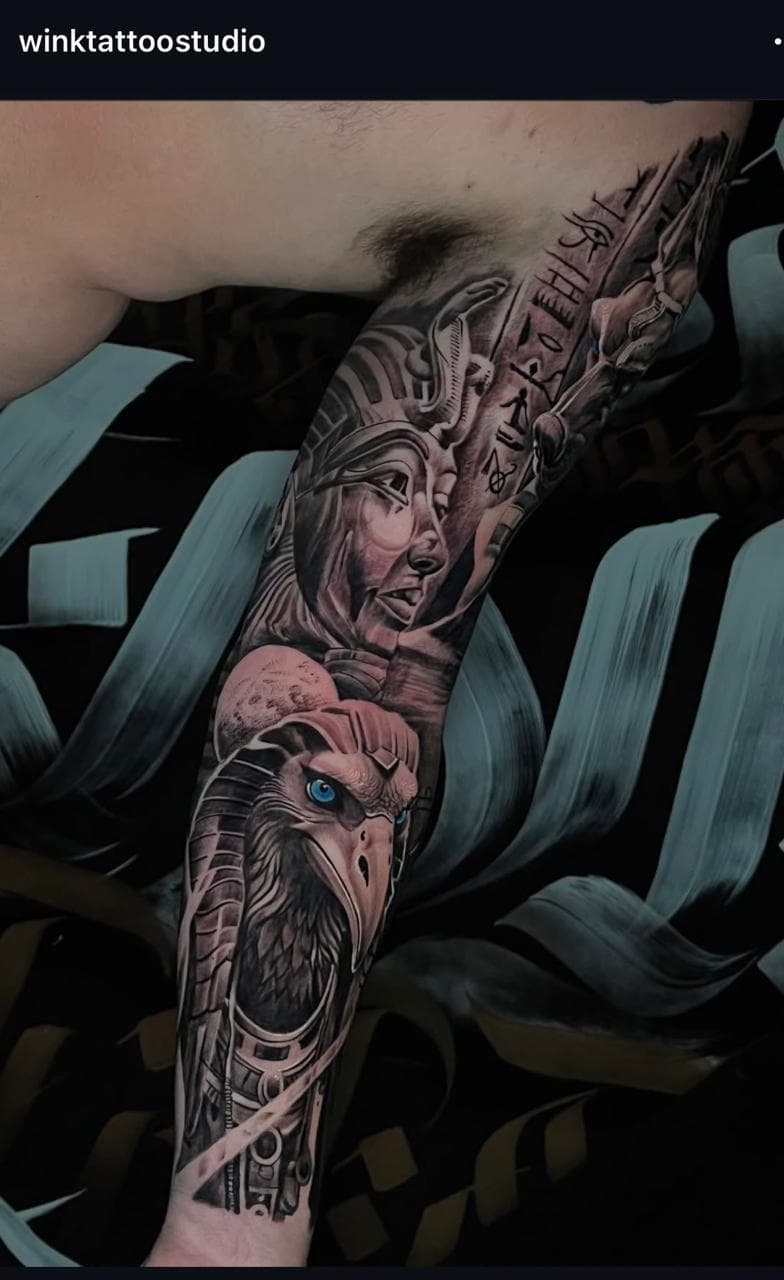
Why Egyptian Imagery Endures
Few visual traditions have as much staying power in tattooing as ancient Egyptian mythology. The imagery is immediately recognisable, deeply layered with meaning, and visually extraordinary — intricate headdresses, profile-facing gods, sacred animals, geometric hieroglyphs, and iconic symbols that have fascinated the world for thousands of years.
Egyptian tattoos tend to be worn by people drawn not just to aesthetics, but to the symbolic weight behind the imagery. Understanding what you're carrying matters.
The Major Deities and Their Meaning
Anubis — god of death, embalming, and the afterlife. Depicted with the head of a black jackal, Anubis guides souls to the underworld and presides over the weighing of the heart. He represents protection of the dead, transition, and judgement. One of the most tattooed Egyptian figures.
Horus — god of the sky, kingship, and protection. Depicted with a falcon head, Horus is one of the most important deities in the Egyptian pantheon. The Eye of Horus (wedjat) is his most famous symbol — a stylised eye representing protection, healing, and royal power.
Ra (Ra-Horakhty) — the sun god, creator, and king of gods. Often depicted with a sun disk above a falcon or ram head. Ra represents light, life, order, and eternal renewal. His daily journey across the sky and through the underworld was central to Egyptian cosmology.
Isis — goddess of magic, healing, motherhood, and protection. Often depicted with outstretched wings, Isis is a symbol of feminine power, fertility, and divine protection. Her myths involve bringing her husband Osiris back from death — making her a figure of transformation and resurrection.
Osiris — god of the dead, resurrection, and agriculture. Depicted as a mummified king, Osiris represents the cycle of death and renewal. He rules the afterlife and judges souls alongside Anubis.
Sekhmet — lioness-headed goddess of war, protection, and healing. Sekhmet embodies raw, fierce power — she is both destroyer and healer, depending on her temperament.
Bastet — cat-headed goddess of home, fertility, and protection. Where Sekhmet is war, Bastet is domesticity and warmth. A beloved and approachable deity.
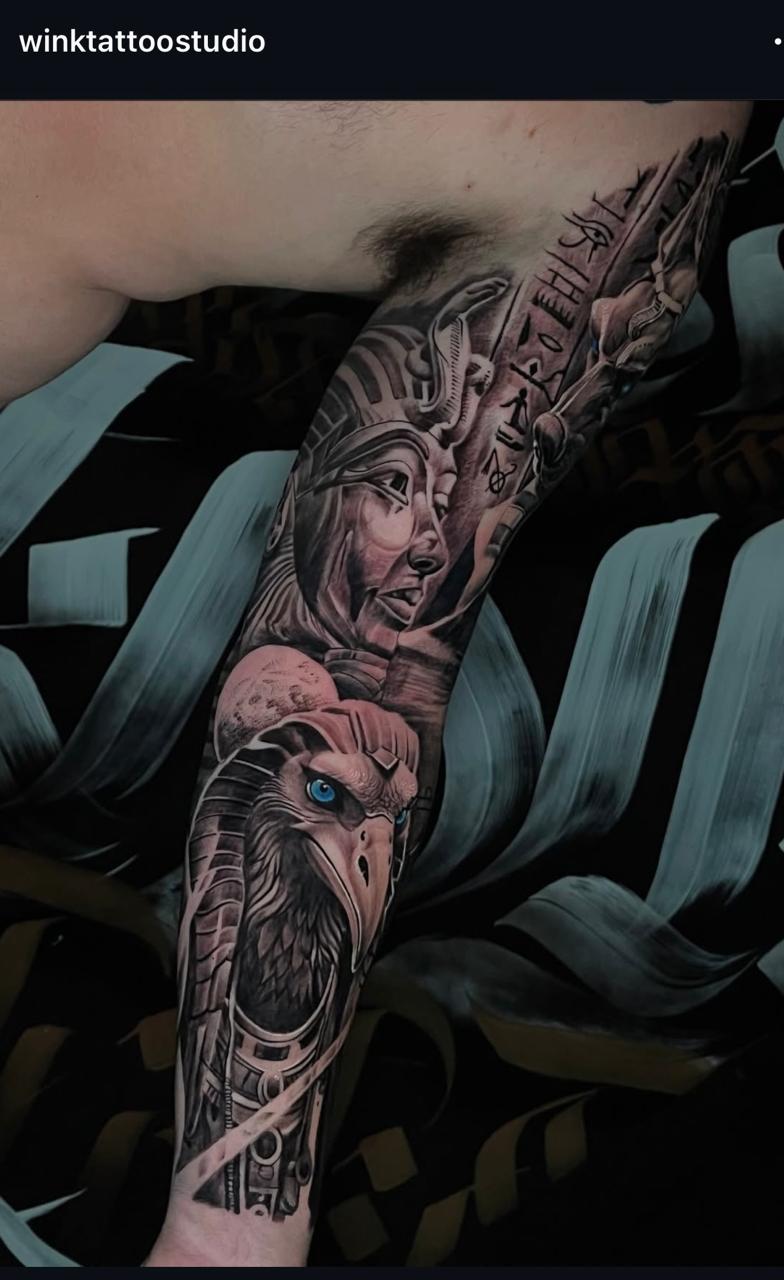
Iconic Egyptian Symbols
Beyond the deities themselves, several Egyptian symbols carry their own meanings and work powerfully as standalone tattoos or compositional elements.
The Eye of Horus (Wedjat) — protection, healing, and divine sight. One of the most universally recognised symbols in tattooing.
The Ankh — the key of life. A cross with a loop at the top, the ankh represents eternal life, immortality, and the union of male and female principles.
The Scarab (Khepri) — transformation, regeneration, and good fortune. The dung beetle that rolls the sun across the sky became one of Egypt's most potent protective amulets.
The Djed pillar — stability, endurance, and the backbone of Osiris. Less commonly tattooed but deeply meaningful.
The Lotus — creation, rebirth, and purity. The lotus flower emerging from murky water became a symbol of creation and the sun rising above chaos.
Which Tattoo Styles Work Best
Egyptian imagery translates across multiple styles:
Black and grey realism is the most popular approach — it renders the intricate detail of headdresses, jewellery, and facial features with photographic precision while giving the figures an otherworldly gravitas.
Linework and blackwork suits a more graphic, hieroglyph-influenced aesthetic — bold outlines, flat fills, and decorative patterning that references the art of the tombs themselves.
Neo-traditional allows for stylised, illustrative interpretations with bold saturation and graphic appeal.
Geometric can incorporate Egyptian symbols — particularly the Eye of Horus and the scarab — within structured geometric frameworks.
Placement Ideas
- Full sleeve — allows for a complete mythological narrative: one deity as the centrepiece, surrounded by secondary symbols, hieroglyphs, and Egyptian motifs
- Chest or sternum — a single deity or the Eye of Horus as a central focal point with radiating detail
- Thigh — portrait-oriented compositions work beautifully here
- Forearm — a single figure or symbol with clean surrounding detail
Coming to Your Consultation
Egyptian tattoos reward careful planning. Consider:
- Which deity or symbol resonates with you, and why
- Whether you want a realistic rendering or something more graphic and stylised
- How the piece fits within any larger collection you're building
- Whether you want to incorporate specific hieroglyphs or personal elements into the design
The mythology is rich enough to build an entire sleeve around. If you have ideas but aren't sure how to structure them into a composition, that's exactly what a consultation is for.