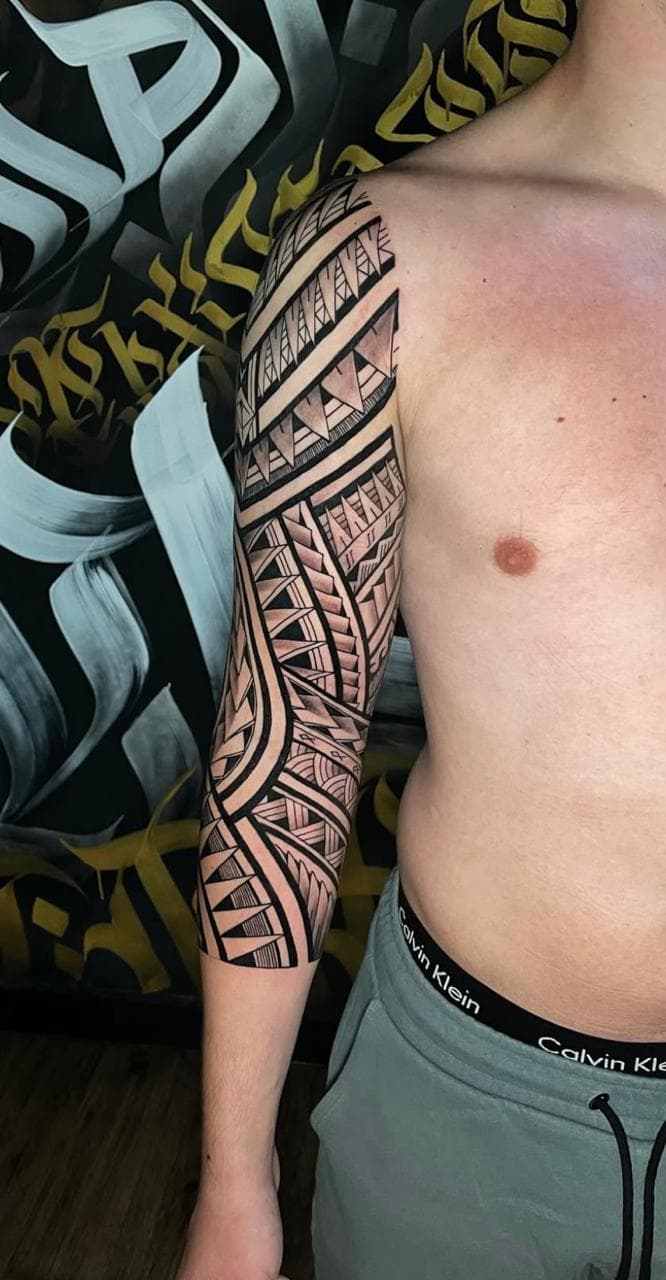
The Style That Refuses to Explain Itself
Not every tattoo carries a story, a symbol, or a meaning that fits into a sentence. Abstract tattooing works from the opposite direction: it is built from shape, line, weight and movement rather than subject matter, and it asks to be looked at rather than decoded.
That is a harder sell than it sounds. Most tattoo culture is organised around meaning — birth flowers, coordinates, portraits, symbols with an agreed reading. Abstract work deliberately steps outside that. For the right person it is one of the most personal approaches there is, precisely because nothing is prescribed.
What Makes a Tattoo Abstract
Abstract tattooing is non-representational. There is no lion, no rose, no figure. The composition is the subject.
The elements an abstract artist works with are the same ones any painter uses:
- Shape — organic marks, hard-edged forms, or a deliberate mix of both
- Line weight — from a single hairline to a broad, solid stroke, and the contrast between them
- Movement — the direction the eye is taken across the skin
- Balance — how mass and open space are distributed, and where the piece is allowed to breathe
- Value — how dark and light areas sit against each other
The result may be quiet and minimal, or dense and energetic. What it will not be is a picture of something.
Abstract-Influenced Approaches
A lot of work people call abstract is really an abstract treatment layered onto a looser structure. Two of the most common:
- Watercolour — pigment applied to create soft bleed, washes and gradient, imitating the way paint behaves on paper. Hard to control on skin, and its lightest areas are the first to fade.
- Brush-stroke work — thick, single-pass strokes that mimic a loaded brush, often with a slightly dry or broken edge. Bold and graphic, and it ages better than watercolour because the marks are heavier.
Both sit on a spectrum. A piece can be fully non-representational, or use an abstract treatment over part of a recognisable subject.
Why Abstract Is Harder Than It Looks
Abstract is unforgiving, and this is the part most people underestimate. When there is a lion in the design, the lion does most of the work — the eye recognises it and is satisfied. There is no such safety net in abstract work. Every mark is doing the whole job, and one poorly placed line or a weak area of contrast has nowhere to hide.
It also means the artist cannot lean on reference. There is no photograph to trace, no subject to check the drawing against. The composition has to be constructed from scratch, which is why abstract work tends to be strongly artist-led.
Designed From the Body Outward
The one thing abstract work shares with every other style is that it has to suit the body it sits on. Because there is no fixed subject, the body itself becomes the reference.
- Muscle and bone landmarks become anchors for the composition.
- The natural flow of an area — how the forearm tapers, how the shoulder rolls — sets the direction of the marks.
- The available space determines how dense or open the piece can be.
This is why an abstract design should not simply be scaled and dropped into place. A drawing made for a flat page needs reworking for a curved, moving surface, and our placement guide covers how differently each area behaves.

Excellent for Cover-Ups and Scar Work
Abstract designs are one of the strongest tools for covering existing work and scar tissue, because they do not need to disguise anything as a recognisable image. Instead of forcing a new subject over an old one, the artist can use flowing, non-representational shapes to absorb the old work and redirect the eye.
That flexibility helps in two ways:
- Cover-ups — covering or reworking an existing tattoo is easier when the new piece is not required to resemble a specific object, because dark areas can be worked into the composition rather than hidden.
- Scar work — as tattooing over scars explains, organic, flowing styles are more forgiving over textured skin than rigid geometry.
Not every cover-up suits an abstract approach, and density still matters, but it is often the most forgiving direction available.
How to Brief an Abstract Tattoo With No Reference Image
Clients often arrive wanting abstract work and apologise for having nothing to show. That is completely normal — the brief simply works differently here.
Instead of reference images of a finished tattoo, useful material includes:
- Adjectives — soft, bold, chaotic, calm, sharp, fluid, heavy, light
- Feeling — what you want the piece to evoke, not what it should depict
- Visual cues from outside tattooing — album art, architecture, textiles, textures you like
- Scale and placement — how much space the piece should occupy and where
- Line quality you are drawn to — the weight of the marks matters more than the motif
Often the most helpful reference is a design the artist has drawn before that you respond to, with notes on what specifically appeals about it. A conversation about the tone of a piece gets an abstract tattoo much further than a folder of images of something else entirely.
Finding Your Fit
You do not need a reason to want an abstract tattoo. You do need to be honest about whether you will be happy living with a piece that reads as texture, movement and shape rather than a recognisable image — and you need to trust the artist to build a composition that works on the body, not just on paper.
Abstract work is not for everyone, but for the person it suits, it can be one of the most honest forms the craft has. There is nothing to hide behind, and nothing to explain. The piece either works as composition or it does not, and when it does, that is the entire point.